
Is Buying a Half Cow Worth It? The Real Cost vs. Grocery Store Prices
By Beef Near Me ·
A half cow usually lands at $6.50–$8.50 per pound of freezer-ready beef. The same basket of ground, roasts, and steaks at grocery prices typically runs 15–30% more. Here's the honest math, including the costs people forget.
Buying a half cow is worth it for most families who eat beef weekly and have (or will buy) a chest freezer. You typically pay $6.50–$8.50 per pound of wrapped, freezer-ready beef for a balanced box of ground, roasts, and steaks — usually 15–30% less than buying the same mix at grocery prices, and often 40%+ less on steak-heavy diets. The trade-offs are the up-front payment, the freezer requirement, and eating the whole animal, not just your favorite cuts.
Here's the honest math, line by line, so you can decide with your own grocery receipts in hand.
How Much Does a Half Cow Cost?
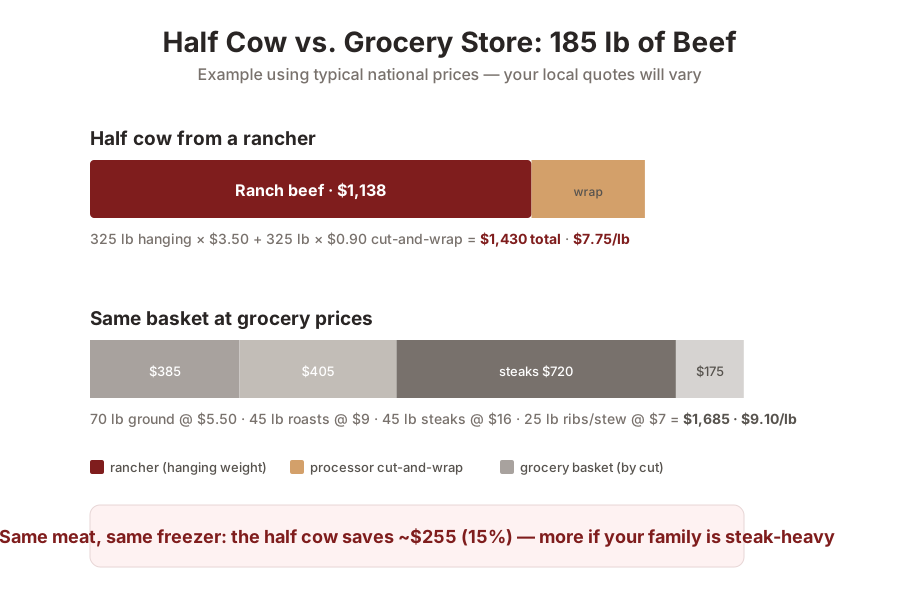
A half cow is priced in two parts: the rancher's price per pound of hanging weight (the carcass weight before cutting, typically 300–400 lb), plus the processor's cut-and-wrap fee per hanging pound. Typical national ranges are $3.00–$4.50/lb hanging from the rancher and $0.75–$1.10/lb for processing. After bone and trim loss, a half yields roughly 150–220 lb of wrapped beef.
Put together, a typical half costs $1,200–$1,700 all-in. Use our bulk beef calculator to convert any rancher's quote into a true cost per pound of freezer beef — that's the only number that lets you compare ranches, or compare against the grocery store.
What Would the Same Meat Cost at the Grocery Store?
To compare fairly, you have to price the same basket: roughly 60 lb ground, 45 lb roasts, 45 lb steaks, and the ribs, stew meat, and bones that come with a half. At typical grocery prices that basket runs 15–30% more than a half cow — and the gap widens dramatically if your family eats more steaks and fewer roasts. A half cow includes ribeyes and filets at the blended price; the grocery store charges $14–$25/lb for those cuts alone.
What Does a Half Cow Include?
Expect about 32% ground beef, 24% roasts, 22% steaks, and the rest in short ribs, stew meat, brisket, soup bones, and filet — the exact split depends on your cut sheet. If your family lives on ground beef and roasts, the savings are modest. If you eat steaks, the savings are large. See our beef cut sheet guide for what each section of the animal yields.
What Are the Costs People Forget?
- The freezer: a half needs 8–12 cu ft. A 15 cu ft chest freezer costs $200–$600 new and about $30–$60/year in electricity. Amortized over several beef purchases, it adds roughly $0.15–$0.40/lb — still usually worth it. (Freezer space guide)
- The deposit: ranchers typically want $100–$400 down to reserve a processing date, sometimes months ahead.
- Waste risk: if you don't actually cook the roasts, that's money in the trash. A half rewards households that meal-plan.
When Is a Half Cow NOT Worth It?
Don't buy a half if you eat less than ~2 lb of beef per week (a half lasts 6–12 months), you can't store it, or you only want specific cuts. A quarter cow or buying individual cuts from a local rancher fits better. Buying local by the cut still usually beats grocery pricing and quality — it just doesn't have the half-cow discount.
How Do You Find a Rancher Selling Halves?
Most small ranches sell halves and quarters seasonally rather than advertise them. Search our directory of local beef farms by state, then call or email the ranches near you to ask about hanging-weight price, processing fees, and next availability. Ask the ten essential questions before you put down a deposit.
The Verdict
For a family of 3–5 that eats beef several times a week: yes, a half cow is usually worth it — expect to save 15–30% versus grocery prices for noticeably better beef, sourced from a rancher you can call. For smaller households or freezer-less apartments: start with a quarter or by-the-cut purchases and graduate up.